The market is a kakistocracy and a kleptocracy. Many 'successful' people are those with the brass neck to cheat, steal and bamboozle those of us who are not unscrupulous enough or brave enough to do likewise. Many of the 'successful', moreover, were given a leg up - daddy's connections, inherited wealth and whatnot. This is a rentier economy of the mediocre, the mad and the bad. I'm reminded of Bolesław Prus's late 19th Century novel 'The Doll', set in Russian-dominated Poland, a society plagued by the inertia, greed and stupidity of its ruling class. I can't read it without thinking that a number of western countries, Britain included, are regressing quickly to the conditions described by Prus.
Showing posts with label reading. Show all posts
Showing posts with label reading. Show all posts
Thursday, 20 April 2017

Monday, 2 May 2016
INVITING US NOT TO CARE
More stuff from the remaindered books outlet which yielded the tiny Jon Ronson gem praised here last week. Another slimline volume. History this time. A short account of the Vietnam War. Not a subject I usually think about a lot. But it came up here quite recently when considering remarks made by Charles Bukowski in 1973 in response to television coverage of freed POWs returning from Indochina:
"The POW propaganda plant is still grinding against all sensibilities. We lost the war, got our asses kicked out by starving men and women half our size. We couldn't bomb, con or beg them into submission so we got out and while getting out, somebody had to come up with a smokescreen to make the populace forget we got our asses kicked."
Bukowski reminds us of how US media outlets focus so sharply on the American casualties of the conflicts into which that great nation so often wades, while saying far less about the vastly more numerous deaths of local civilians caught in the crossfire. These thoughts led me to the discovery of a 2012 article in which John Tirman discusses the question of why US citizens appear inclined to ignore the civilians killed in "American wars". Tirman notes that "the lack of concern about those who die in U.S. wars is... shown by these civilians' absence, in large part, from our films, novels and documentaries" and that "the entertainment industry portrays these wars... almost always with a focus on Americans."
I don't think it's fair to single out the USA as the only nation where this approach to describing armed conflict is the norm. My sense is that here in the UK, for example, the media and entertainment industries similarly combine to create narratives in which foreign civilians and enemy combatants are pushed towards the margins and the background.
One would hope, though, that history books authored in the countries on one side of a conflict would pay more attention to the civilian casualties sustained by the other side, as well as attempting to explore the perspectives of the people living on that other side. I'd like to keep nursing that hope, notwithstanding old warnings about there being no such thing as a truly neutral, objective or even-handed historian. At first sight, though, this recently acquired book about the Vietnam War seemed to suggest that its account of the conflict would be in keeping with John Tirman's observations about a lack of concern for the civilian victims of wars contested by the USA: the cover is illustrated with a photo of an American soldier's helmet; the blurb on the back of the book speaks of 58,220 American dead and 300,000 American wounded, without mentioning equivalent figures for the Vietnamese population. True, the middle paragraph of that blurb does suggest that the author has attempted to tell the story of the war from the Vietnamese perspective, noting that for "the people of North Vietnam is was just another in a long line of foreign invaders" and observing that "for two thousand years they had struggled for self-determination". But that insistence on citing the numbers of American casualties only does create the impression that this book is yet another predominantly US-centric account of the conflict. It is a pity that the publisher's people felt the need to take this approach, and they have done the Scottish author of the book a disservice, I feel, because the opening chapters do say rather more about the Vietnamese perspective than the blurb and the cover image had led me to expect. I feel, then, that the publisher's marketing people decided that they needed to sideline Indochinese civilians, combatants, history and politics in order to package a palatable product for an audience endlessly invited not to care about dead foreigners. The disservice done by this approach, then, is done not only to the author but also to those of us with the capacity to feel for the fallen on both sides of a conflict.

Monday, 25 April 2016
EVER GET THE FEELING YOU'VE NOT BEEN CHEATED?
Of late, my footsteps keep taking me past the clutter of a decent remaindered books outlet in the West End of that London. I've taken to stopping in for a brief mooch, mindful of all the interesting reads I've been turned onto by these places over the years, as mentioned in a recent ramble around the upside of time-killing.
This particular shop has proven to be particularly well-stocked with the works of Jon Ronson, hence their numerousness on the this is my england reading list. In theory, I would have been happy to pay full price for any of these. It also seems unfortunate that non-fiction as consistently interesting and amusing as Ronson's can be had from the bargain bins. But the remaindering process is a gift horse. My means are not unlimited. So I cannot look it in the mouth.
On the most recent trip to this shop, I picked up another of Ronson's books, wondering for the first time ever whether he had written something unlikely to be worth the discounted price I'd paid for it, let alone the original full price. It was, after all, extremely slender, weighing in at barely seventy pages. But given than less can be more, I was more wary of the subject matter than of the feathery size of this little thing. I was never, after all, much of a fan of Frank Sidebottom, the singing papier-mâché head brought squeakily to life in the 1980s and 1990s by the late Chris Sievey.
I did get the joke. Being a soft southern git did not prevent me from appreciating the comic mismatching of musical forms with obscure references to the quotidian details of life in the north of England. I must have even had some level of appetite for that particular brand of comedy because Half Man Half Biscuit were a fixture of my teenage mixtapes for a while. I was a fan of The Fall, too, a fact I mention because I contend that the magic realism of Mark E. Smith's lyrics and the knowing dourness of his delivery combine to create a comic effect not unalike the ones conjured up by Frank Sidebottom or by the post-punksters from the Wirral peninsula.
I just felt that the Birkenhead combo did the whole northern absurdism bit more amusingly and more satisfyingly than the persona created by Chris Sievey. Good grounds, then, for wondering how much I would enjoy Ronson's brief account of his time as a member of Frank Sidebottom's Oh Blimey Big Band and of his later co-writing of a fictionalised movie version of Sievey's strange life.
I needn't have entertained these doubts. I demolished those seventy pages in the time it took to eat some sushi and take two tube rides. On both journeys, I was that passenger you sometimes see struggling to suppress loud laughter and wiping hot tears of mirth from his face. This is only partly because the dingy gig venues and Students Union ENTS office described by Ronson were so close to the wonderful, half-recalled shitholes of my own youth. It is simply very funny and sweetly sad. So DO buy this. Buy it for very little in the remaindered book store. Or buy it full price. But get it. Get it.

This particular shop has proven to be particularly well-stocked with the works of Jon Ronson, hence their numerousness on the this is my england reading list. In theory, I would have been happy to pay full price for any of these. It also seems unfortunate that non-fiction as consistently interesting and amusing as Ronson's can be had from the bargain bins. But the remaindering process is a gift horse. My means are not unlimited. So I cannot look it in the mouth.
On the most recent trip to this shop, I picked up another of Ronson's books, wondering for the first time ever whether he had written something unlikely to be worth the discounted price I'd paid for it, let alone the original full price. It was, after all, extremely slender, weighing in at barely seventy pages. But given than less can be more, I was more wary of the subject matter than of the feathery size of this little thing. I was never, after all, much of a fan of Frank Sidebottom, the singing papier-mâché head brought squeakily to life in the 1980s and 1990s by the late Chris Sievey.
I did get the joke. Being a soft southern git did not prevent me from appreciating the comic mismatching of musical forms with obscure references to the quotidian details of life in the north of England. I must have even had some level of appetite for that particular brand of comedy because Half Man Half Biscuit were a fixture of my teenage mixtapes for a while. I was a fan of The Fall, too, a fact I mention because I contend that the magic realism of Mark E. Smith's lyrics and the knowing dourness of his delivery combine to create a comic effect not unalike the ones conjured up by Frank Sidebottom or by the post-punksters from the Wirral peninsula.
I just felt that the Birkenhead combo did the whole northern absurdism bit more amusingly and more satisfyingly than the persona created by Chris Sievey. Good grounds, then, for wondering how much I would enjoy Ronson's brief account of his time as a member of Frank Sidebottom's Oh Blimey Big Band and of his later co-writing of a fictionalised movie version of Sievey's strange life.
I needn't have entertained these doubts. I demolished those seventy pages in the time it took to eat some sushi and take two tube rides. On both journeys, I was that passenger you sometimes see struggling to suppress loud laughter and wiping hot tears of mirth from his face. This is only partly because the dingy gig venues and Students Union ENTS office described by Ronson were so close to the wonderful, half-recalled shitholes of my own youth. It is simply very funny and sweetly sad. So DO buy this. Buy it for very little in the remaindered book store. Or buy it full price. But get it. Get it.

Wednesday, 20 April 2016
all progress depends on the unreasonable man
sometimes I enjoy a well-known quotation so much that it becomes a staple of my conversation. I'll reach for it whenever it seems apposite. I probably overdo it sometimes. one such much-loved quote has cropped up once or twice on this is my england. it is a remark made by George Bernard Shaw, suggesting that we avoid the temptation to get drawn into debates with those who refuse to play nice in a lively exchange. Shaw talks to us in terms of wrestling with a pig.
this image is most likely to surge to the front of my mind when I'm feeling the urge to spar with the writers of very horrible comments added, below the line, to articles or news items presented to me on the laptop screen or on the phone. same thing back when I used to bother with Internet messageboards. it can happen in the context of Twitter, too, of course.
no huge surprise, then, to find myself stumbling upon another Shaw quote today and deciding that it may well become as well-liked and come to be(over)used as regularly as the pig wrestling bit:
"The reasonable man adapts himself to the world; the unreasonable one persists in trying to adapt the world to himself. Therefore all progress depends on the unreasonable man."readers who are more well-read than me. readers who are better educated. readers who really KNOW their Shaw. they may all be smiling, sighing or eye-rolling at the spectacle of a middle-aged blogger only coming to know of the above quotation today. at the childlike wonder with which he's enjoying it as something fresh. at the idea that he openly professes the likelihood of working into his limited repertoire of rhetorical flourishes. but I don't mind. I'll never meet you anway. and I like it. just like it. find it pleasing. find it to be neatly and so, so obviously useful and versatile. and I like the slim, slight book in which it cropped up for me today. more on that soon.
Saturday, 26 March 2016
POTEMKIN VILLAGES DE NOS JOURS
Early days when it comes to a recently acquired book about Russians opposed to the rule of Putin. I've not yet turned as many pages as I'd like. This is not because the book appears to be uninteresting or otherwise heavy going. It's more a case that finding the time to read purely for pleasure continues to be a bit tricky due, I think, to a combination of factors: the nonsensical deadlines and weird hours of my currently (interim/temporary) BULLSHIT JOB; fair chunks of remaining free time spent pounding a treadmill, jumping onto boxes, curling the biceps etc.; a bit of running around to prepare for the keenly anticipated mega-vacation in the USA.
But just a short way into Panyushkin's Twelve Who Don't Agree, one strange detail caught my eye, sharpening my keenness to read on and learn more. The author, a Russian journalist, describes a St. Petersburg protest march which he covered in 2007:
"A line formed that was no fun to stand in. According to long tradition, the authorities drove a couple of hundred homeless to every opposition rally for the purpose of displaying the drunken riffraff who constituted Putin's opponents. In exchange for participating in the country's political life, the homeless demand vodka but not to be allowed to wash."
Thus far, I've not managed to Google up any other references to the practice alleged here to be a be a "long tradition" for Russia's security forces. Whether or not this actually is a real tactic used by the Kremlin & co. to discredit those who organise against the regime, the image is a colourful one, reminiscent of other ruses that come to mind.
For example, I'm reminded of a recent UK news story, reporting that Transport for London engineers were instructed to waste time digging a superfluous hole near Northumberland Park station purely to serve as a prop for a photoshoot involving George Osborne and Zac Goldsmith.
Turning my thoughts back to Putin's Russia, this idea of creating a completely false impression of how things really are by means of logistically complex dissembling reminds me, naturally enough, of the concept of the Potemkin Village. As I make further progress with Panyushkin's book, let's see if more elaborate, sinister ridiculousness of this sort is alleged and described.
Saturday, 19 March 2016
ON THE FRUITFULNESS OF KILLING TIME
The BULLSHIT JOB that I'm doing at the moment can be done at home. So I do it at home, working odd hours and finding time to do less bullshit things between the various bullshit tasks involved. Hence going to the gym at 10.00 in the morning to be put through my paces by a muscular, cheerful dude who calls me buddy and scores higher for emotional intelligence and bedside manner (well, the personal trainer equivalent thereof) than pretty much any other person I can think of. Smashing off my visceral fat. Buying me a few more years, maybe. Getting the old body to the point where no it no longer feels like I'm dragging around an awkwardly proportioned sack of shit. That is actual progress. There's a spring in my step and my lower back doesn't grumble any more, even after a night spent on a blow-up bed when guest bedrooming somewhere. I have actual fucking biceps, fer chrissakes. Not noticeably large. But there. Really there.
Anyway, after an hour of strong mind, buddy and get your foot higher for me, buddy, I was nauseous and fully wiped out. Had to sit, bewildered, on a PLYO SOFT BOX for what seemed like ages before I could make it out of the sweaty kit and into the shower. Then the shower went on an on and on. Wasteful. Superb. So I get out of there and it's an awkward time. I can't brunch because I breakfasted. I can't lunch because it's not yet midday. Twenty-plus minutes shy of noon, in fact. What to do? Ours is not a town where there's much to do on a grey day bedevilled by insistent, pissy drizzle. So I went into Waterstones because I can always stand to look at books. Even in a weirdly deficient branch of Waterstones - massive children's dept., acres of business books and a dismally small fiction section that's mostly airport stuff. But my eye was drawn to a tray full of books marked all the way down to ONE POUND. 99.9% dross, of course. But then I saw a neat little volume containing profiles of 12 Russians who don't like Putin. I'll have some of that, I decided. I've lost count of the genuinely interesting things I've picked up in those places that only sell remaindered books. It was in one of those places that I got turned on to Ismail Kadare, fer chrissakes. So my mind is always open to the possibility of being led somewhere stimulating by a bargain pick-up. Let's see. Perhaps it'll make it into the suitcase as holiday reading for the impending trip to the USA. So I went off to get my chicken burger with a hopeful smile, my freshly battered flesh notwithstanding. I got them to hold the mayo and the sickly-sweet onion relish, replacing these with jalapeños. I like a slight frosting of sweat on the brow when eating chicken. Then back to the BULLSHIT JOB.

Anyway, after an hour of strong mind, buddy and get your foot higher for me, buddy, I was nauseous and fully wiped out. Had to sit, bewildered, on a PLYO SOFT BOX for what seemed like ages before I could make it out of the sweaty kit and into the shower. Then the shower went on an on and on. Wasteful. Superb. So I get out of there and it's an awkward time. I can't brunch because I breakfasted. I can't lunch because it's not yet midday. Twenty-plus minutes shy of noon, in fact. What to do? Ours is not a town where there's much to do on a grey day bedevilled by insistent, pissy drizzle. So I went into Waterstones because I can always stand to look at books. Even in a weirdly deficient branch of Waterstones - massive children's dept., acres of business books and a dismally small fiction section that's mostly airport stuff. But my eye was drawn to a tray full of books marked all the way down to ONE POUND. 99.9% dross, of course. But then I saw a neat little volume containing profiles of 12 Russians who don't like Putin. I'll have some of that, I decided. I've lost count of the genuinely interesting things I've picked up in those places that only sell remaindered books. It was in one of those places that I got turned on to Ismail Kadare, fer chrissakes. So my mind is always open to the possibility of being led somewhere stimulating by a bargain pick-up. Let's see. Perhaps it'll make it into the suitcase as holiday reading for the impending trip to the USA. So I went off to get my chicken burger with a hopeful smile, my freshly battered flesh notwithstanding. I got them to hold the mayo and the sickly-sweet onion relish, replacing these with jalapeños. I like a slight frosting of sweat on the brow when eating chicken. Then back to the BULLSHIT JOB.

Tuesday, 15 March 2016
AMAZON TO FLORIDA
another birthday last month. well spent, too. which is unusual for me. well spent on a trip down to chichester, where we ate well, had front row seats at a STEWART LEE gig and dropped in on a dear old friend of mine. seeing my pal was good in itself. but he also went on to recommend a book that's stirred up a few ideas and given some pleasure in the weeks following the visit.
looking back at that enjoyable weekend away and looking forward to a trip to NEW YORK and FLORIDA that is now less than three weeks away, I do count myself a fortunate fellow. yes, yes.
NEW YORK will be a whirlwind. not even two full days into which a blaze of experiences must be crammed. I've been there before. but this will be my son's first trip to the city and he's anxious not to spend a single moment doing anything as dull as pausing for breath in a hotel room. so we must flash past a number of the main tourist sights, gorge ourselves on suitably american food, catch up with relatives and a family friend who live in manhattan AND sit through our first ever in-the-flesh NBA game.
FLORIDA will be different. yes, the last bit of our stay down there will be somewhat eventful. but before we go, briefly, all resort hotel and theme park, we will linger longer in the very familiar stretch of U.S. suburbia and american edgelands around which one of my sets of in-laws can be found. no wifi in the house, amazingly! and I can only take so much sun, pale-complexioned, freckle-dotted english rose that I am. and only so many longlonglong infomercials on the tv. so: BOOKS.
good timing, then, that birthday of mine, not least because my other set of in-laws (the just up the road from here in-laws) always ping me a generously fat amazon top-up to mark the passing of another year of this life i'm living. here is the haul, almost all stuff written by familiar writers I can trust to do it for me. intrigued to see if a favourite will emerge in the FLORIDA sunshine between trips to the giant fridge for another weak, pale beer or another helping of HEARTS OF PALM salad:


NO SPECIAL QUALITY OF HEROISM
As discussed little while ago, I recently picked up the latest(?) posthumously assembled collection of never-before-seen (and previously-not-widely-seen) stuff by Charles Bukowski. Yet another volume for the collection.
Last time, I referred to The Bell Tolls for No One as a ragtag collection of short stories. But, having finally read the whole book now (I'm reading for pleasure much less often and much more slowly these days), I see that it's perhaps better to describe it as a mishmash of short pieces of writing.
Yes, of the various forms you will find between the covers of this collection, (familiar!) little stories grown from the kernels of real incidents in Bukowski's life are the most numerous. Yes, also well-represented here are small bits of dirty, ludicrous, fantastical fiction, each one realised over just a few pages: a factory worker shares an apartment with an ageing Adolph (sic) Hitler who is planning to populate the world with horrible creatures born of bathtub flatulence; a cop is kidnapped by a cast of grotesque, Rabelaisian and murderous criminals residing in a crumbling Hollywood mansion; in two separate but strikingly similar stories, mid-air havoc is wreaked by savage, perverted n'er-do-wells terrorising commercial flights.
But among all this fiction, we can discover think pieces that Bukowski contributed to underground newspapers such as Open City. Even in this context, the author tends towards anecdotes of a highly personal nature rather than towards pronouncing on the important and popularly discussed issues of the time.
But in the pages of The Bell Tolls for No One we do find one example of a form that Bukowski almost never used, namely straight socio-political commentary conveying a definite set of opinions presented plainly and unambiguously. This appears as the first part of a 1973 L.A. Free Press column, which does soon revert to something closer to one of the author's usual preferred forms, in this case a first person account of a friend telling a surreal yarn. But for a page-and-a-half, Bukowski writes about the then highly topical issue of American prisoners of war left behind in Vietnam:
But in the pages of The Bell Tolls for No One we do find one example of a form that Bukowski almost never used, namely straight socio-political commentary conveying a definite set of opinions presented plainly and unambiguously. This appears as the first part of a 1973 L.A. Free Press column, which does soon revert to something closer to one of the author's usual preferred forms, in this case a first person account of a friend telling a surreal yarn. But for a page-and-a-half, Bukowski writes about the then highly topical issue of American prisoners of war left behind in Vietnam:
The POW propaganda plant is still grinding against all sensibilities. We lost the war, got our asses kicked out by starving men and women half our size. We couldn't bomb, con or beg them into submission so we got out and while getting out, somebody had to come up with a smokescreen to make the populace forget we got our asses kicked. Let's build the POW angle, they said, and so it began. Bob Hope became concerned about the POWs; his wartime Santa Claus kick had rather petered out in the last two trips. The word was out and the act was in. The arrival of the first POWs was put on tv. Here came the plane in. And we waited and waited and the plane taxied and taxied. You never saw a plane taxi that much in any airport at any time in the world. The cameras waited and they bled it to death. Then out came the first grand POW and patriotism was back.
These words written in the early 1970s took me back to the mid-1980s and to the first time I had any notion of a war in Vietnam having taken place. I was in my mid teens. Paul Hardcastle's 19 hit the top of pop charts here in Britain and in many other countries. I clearly recall that several of our broadsheet newspapers took this as a cue to run Sunday supplement pieces on the Vietnam War. Up to then, then, I had been only dimly aware of this war. Fair enough. After all, the conflict had spluttered to its untidy conclusion when I was just five years old. I don't remember my parents speaking about it and it certainly hadn't been covered as part of the history curriculum at school.
Something about the madness, the pointlessness and ugliness of America's ill-fated adventure in Indochina caught my adolescent imagination. So I went on to watch the movies Apocalypse Now and Platoon and the TV series Tour of Duty with morbid interest. Little by little, it dawned on me that all of these works of fiction seemed to be presenting Americans (if not America) as (the) victims of this war. Little by little, it occurred to me to wonder why the suffering and the deaths of Vietnamese combatants and civilians is passed over so lightly in these films and TV shows. Were they not victims too? If you really want to get into it, didn't the people of Vietnam suffer rather more badly than the fighting men of the USA?
In those movies and TV series we see American conscripts and professional soldiers broken, brutalised and horrified by the things they see and do. We see American families and communities traumatised by grief for their dead or by the psychological and physical damage sustained by returning veterans. So we should, because, undeniably, tours of duty in Vietnam did ruin the minds and bodies of many American men. Men of modest means, on the whole, of course. Men whose families did not have the connections and wealth enjoyed by the parents of draft-dodgers such as Donald Trump, George W. Bush, Bill Clinton, Karl Rove and Dick Cheney.
In those movies we see American men dying in battle too, of course. So we should, because around 60,000 US service personnel lost their lives during the Vietnam War.
Big numbers, yes. Horrible things, definitely. Big, bitter divisions in American society. So of course it's a big deal. Of course movies and TV dramas have explored this American suffering. But are these really big numbers when set side-by-side with a tally of dead and wounded Vietnamese, Cambodian and Laotian people? No. Decidedly not. Because between 400,000 and 900,000 North Vietnamese Army and Viet Cong personnel died in the war. Around 250,000 members of the Army of the Republic of Vietnam (America's allies) were killed. Civilian deaths? Estimates vary wildly, but most seem to place the number at well over 1.5 million.
In this context, wouldn't a truly compassionate account of the Vietnam War focus to some degree on the suffering of the Vietnamese people as well as on the miseries of American servicemen? But I think about those movies and TV shows. As far as I recall, the makers of these fictional accounts of the war make no meaningful attempt to convey the scale of the horror visited upon the people of Vietnam and neighbouring countries. This makes it hard not to form the impression that Hollywood doesn't give a fuck about dead foreign civilians.
I am not alone in arriving at this conclusion. In a 2012 article which asks a wider question about why Americans ignore the civilians killed in "American wars", John Tirman notes that "the lack of concern about those who die in U.S. wars is... shown by these civilians' absence, in large part, from our films, novels and documentaries" and that "the entertainment industry portrays these wars... almost always with a focus on Americans."
For my own part, I believe I am capable of sustaining a compassionate response to the plight of the Vietnamese dead and wounded and to the tribulations of conscripted men from poor neighbourhoods across America. I'd certainly welcome a novel, movie or TV drama on the theme of the Vietnam war which invites and allows me to experience both feelings at once. But I do understand why others might consider the existing Hollywood and TV treatments of the Vietnam war and grow weary of being expected to sympathise only with the battered and blooded GIs. It was with this in mind that I read on as as Bukowski continued with his reaction to the return of American POWs:

Something about the madness, the pointlessness and ugliness of America's ill-fated adventure in Indochina caught my adolescent imagination. So I went on to watch the movies Apocalypse Now and Platoon and the TV series Tour of Duty with morbid interest. Little by little, it dawned on me that all of these works of fiction seemed to be presenting Americans (if not America) as (the) victims of this war. Little by little, it occurred to me to wonder why the suffering and the deaths of Vietnamese combatants and civilians is passed over so lightly in these films and TV shows. Were they not victims too? If you really want to get into it, didn't the people of Vietnam suffer rather more badly than the fighting men of the USA?
In those movies and TV series we see American conscripts and professional soldiers broken, brutalised and horrified by the things they see and do. We see American families and communities traumatised by grief for their dead or by the psychological and physical damage sustained by returning veterans. So we should, because, undeniably, tours of duty in Vietnam did ruin the minds and bodies of many American men. Men of modest means, on the whole, of course. Men whose families did not have the connections and wealth enjoyed by the parents of draft-dodgers such as Donald Trump, George W. Bush, Bill Clinton, Karl Rove and Dick Cheney.
In those movies we see American men dying in battle too, of course. So we should, because around 60,000 US service personnel lost their lives during the Vietnam War.
Big numbers, yes. Horrible things, definitely. Big, bitter divisions in American society. So of course it's a big deal. Of course movies and TV dramas have explored this American suffering. But are these really big numbers when set side-by-side with a tally of dead and wounded Vietnamese, Cambodian and Laotian people? No. Decidedly not. Because between 400,000 and 900,000 North Vietnamese Army and Viet Cong personnel died in the war. Around 250,000 members of the Army of the Republic of Vietnam (America's allies) were killed. Civilian deaths? Estimates vary wildly, but most seem to place the number at well over 1.5 million.
In this context, wouldn't a truly compassionate account of the Vietnam War focus to some degree on the suffering of the Vietnamese people as well as on the miseries of American servicemen? But I think about those movies and TV shows. As far as I recall, the makers of these fictional accounts of the war make no meaningful attempt to convey the scale of the horror visited upon the people of Vietnam and neighbouring countries. This makes it hard not to form the impression that Hollywood doesn't give a fuck about dead foreign civilians.
I am not alone in arriving at this conclusion. In a 2012 article which asks a wider question about why Americans ignore the civilians killed in "American wars", John Tirman notes that "the lack of concern about those who die in U.S. wars is... shown by these civilians' absence, in large part, from our films, novels and documentaries" and that "the entertainment industry portrays these wars... almost always with a focus on Americans."
For my own part, I believe I am capable of sustaining a compassionate response to the plight of the Vietnamese dead and wounded and to the tribulations of conscripted men from poor neighbourhoods across America. I'd certainly welcome a novel, movie or TV drama on the theme of the Vietnam war which invites and allows me to experience both feelings at once. But I do understand why others might consider the existing Hollywood and TV treatments of the Vietnam war and grow weary of being expected to sympathise only with the battered and blooded GIs. It was with this in mind that I read on as as Bukowski continued with his reaction to the return of American POWs:
A POW is a man who went to war knowingly, knowing he might kill or be killed, capture of be captured, maim or be maimed. These is no special quality of heroism in this. There are few real patriots anymore, there have been too many useless wars and they have come too fast.
Most American men of war age merely took a gamble; they figured by going that the odds against them actually getting killed were high. By going and returning, whether they believed in the war or not, they would still retain their decent citizen status and be able to return to their women and their jobs and their homes and their baseball games, their new cars. By refusing they faced imprisonment and/or hiding.
Most weighed it all and considered that going to war was the easier way, especially those with college educations and ROTC training who were able to fly above the muck and blood, only pushing buttons. That some of them became POWs was just tough shit of the spinning of the wheel and they know it better than anybody. And if they are given a free fuck now or a free automobile or applause or a good job, they're going to take that too.
The other night at the Olympic Auditorium boxing matches, a former POW was introduced and he got up into the ring and was given a standing ovation. I once had an almost-admiration for boxing fans. I now see them in a different magenta lavender brownsmear hue...

Sunday, 28 February 2016
WWBAGWFT2: NOT DESIRE PATHS BUT...?
Just over a week ago, I dropped in on an old friend who lives just outside Chichester. My pal is a big reader - has worked in publishing for ages; used to work in bookshops; used to send me bundles of books to keep me supplied with fresh reading material when living in my pre-Internet Poland of the early-to-mid nineteen nineties.
We only had about an hour to chat and to look around the new house he's just moved into with his wife and two wonderfully polite daughters, all of whom were at home when we stopped by. So there was little time for one of our proper catch-ups. But I could tell he'd read something new and had it on his mind. I noticed that he kept returning, a little obliquely, to the concept of unloved, unlovely places at the edge of town and country. Every now and then, with just a few words, he would capture quite evocatively the essence of these ignored strips and patches of land. More than once he used the term edgelands. Something about how he emphasised this word suggested that it was one around which he'd lately and repeatedly been wrapping his mouth and mind. But for whatever reason, I didn't pick up on this possible cue to ask more about this apparent neologism, edgelands. I guessed, however, that he and I would return to this theme some time soon.
So it came to pass. Two days later, my friend asked me if I knew of a book titled Edgelands. I replied that I did not. Shortly after that, I was surprised to receive said book by post, courtesy of my thoughtful pal. Replying to my words of thanks, he advised me that he'd "found it to be a mixture of fascinating, amusing, concerning and slightly irritating but a good read nonetheless." I am part of the way through it and I am minded to agree with my friend's words. I do feel that the book contains much to admire while being, at the same time, frustratingly unsatisfying in places.
Much of the photography and, I think, a little of the writing, here at this is my england (and the associated Instagram account) is evidence of my interest in the kind of spaces and atmospheres explored by Paul Farley and Michael Symmons Roberts (both are poets) in Edgelands. In fact I'd really like to find my own ways to capture the essence of these untidy places in my own short stories and attempts at poetry. Effective ways, I mean. Ways that properly please me if no one else.
Overall, then, it feels like I keep nodding with approval as the two poets put into words a half-formed notion that I've never properly articulated myself. But then, rather more often than I'd like, I feel that the Edgelands authors miss the mark, even if only by a fraction. It's like this book reminds me of an itch... and then fails to scratch it. So at some point, I may feel inclined to say more about Edgelands. But for now I just want to express my dissatisfaction with one particular term coined by the authors.
Consider the photograph below. It shows part of the route I must take if, as now, I find myself travelling, daily, in and out of London in pursuit of a living. Here, I am drawing close to the station near my home:

These countless tiny decisions and a surprisingly clear picture of the corner shown above both sprang immediately to mind when reading the following passage from Edgelands:
The post-war overspill developments seen on the edges of many of our cities were planned right down to every concrete walkway, subway and pathway. But their green squares and verges were soon criss-crossed with desire paths: a record of collective short-cuttings. In the winter, they turned to sludgy scars that spattered trousers and skirts and clung to shoes, and during hot summers they turned dusty and parched. Once established, they fell into constant use, footpaths which have never entered the literature. These footpaths of least resistance offer their own subtle resistance to the dead hand of the planner.
I enjoyed almost every word of this. Almost. But "desire paths"? No, no. This term really doesn't cut it for me. On one hand the Edgelands writers very deftly bring into "the literature" an instantly recognisable feature of urban and suburban environments which has escaped the descriptive remit of other texts. But on the other hand, once conjured into something tangible, this quotidian phenomenon is mislabelled with a term that seems altogether too attractive. Sylvan, even, speaking to me of improbably nubile faeries leaving traces of their passing across the glistening caps of dewy toadstools. This is about real people cutting across real patches of grass, using the spaces they live in (or travel through) not quite as the planners hoped. Nothing more. No faerie dust. No longing. No lust. So wherefore desire?
So I am looking for a more suitable alternative term for desire paths while being mindful that it may be difficult to create a sufficiently elegant one. But maybe such a term exists in German? Or, if not, perhaps a native speaker of German would find it easier to create one than would a Brit or an American. After all, just over a month ago, this is my england noted that "the German language outperforms English in one important area - a facility for the creation of abstract nouns which neatly (i.e. with one word, albeit sometimes a rather long one) convey quite complex and highly specific concepts or emotional states." This observation was followed up with a rambling attempt to convey certain frustrating emotions experienced (by me, anyway) at pelican crossings and an appeal for passing German speakers to encapsulate these with spiffy new nouns. I asked, then, "What Would Be a German Word for That?"
So, dear German reader (or, more realistically, M.P. Powers) - these desire paths of Paul Farley and Michael Symmons Roberts: What Would Be a (Better!) German Word for That? Yeah, this is #WWBAGWFT2.
Tuesday, 19 January 2016
ONE PERSON WHO CARES VERY MUCH
I don't often think about Bukowski these days. Years ago, I used to think about him and his writing a lot. So much so, in fact, that the first thing I ever really did on the internet was to build a very simple Charles Bukowski tribute website. In 1998, I think. That led to seeking out fellow fans of the man's work, a number of whom used to hang out in a dingy corner of usenet set up ostensibly to host discussions about the Dirty Old Man of San Pedro. I say ostensibly, because Bukowski was rarely discussed there. The main action was endless flame-wars, some interesting, some dull, some demented. I remain friendly with one of the former habitués of that group, the Chicago-born, Florida-raised and now Germany-based M.P. Powers, author of the novel Fortuna Berlin.
Powers has been a good listener and a damn good talker on the numerous occasions I've met him - in Boynton Beach, in Miami, in Palm Beach, in Berlin and in London. We've corresponded a fair bit, too, over the long years since sometimes finding ourselves on the same side of this or that fight between warring usenet lunatics in the late nineties. So I think (without checking) that I am right when stating that I seem to remember him saying he doesn't care much for most (all?) of the posthumously-released collections of previously unpublished (or unpublished in book form) Bukowski stuff. He is not alone in this. A good number of Buk enthusiasts seem to baulk at paying for scraps and cast-offs of dwindling quality as the late author's last remaining cupboards, notebooks and waste-paper baskets are wrung dry.
There is something in this. But for all that, I do continue to buy this stuff when it comes out, the most recent acquisition being The Bell Tolls For No One, a ragtag of short stories, many (but not all) of which are from Bukowski's L.A. Free Press column of the 1970s. Based on what I've read so far, the quality is patchy. What's more, as I started to read, I decided that I couldn't be certain that I was reading some of this material for the first time ever. Because as many who have read a lot of Bukowski's prodigious output can confirm, the Dirty Old Man endlessly retold, refined and reworked a number of (apparently/supposedly) real incidents from his own life across short stories, poems and sections of his novels, adding and omitting details with each retelling.

This very point is mentioned in the introduction to this collection, written by its editor David Stephen Callone:
Several of the stories included in this volume demonstrate how [Bukowski] worked and reworked [his] material. He creates the same narrative anew; he doesn't copy, but starts over. He is always retelling his autobiography but selecting different details, reinventing instead of rewriting... It is typical of Bukowski's method of selecting episodes from his life and reworking them, adding specific details and usually elaborating on reality by adding invented plot elements. He is constantly engaged in telling and retelling his life, giving it the structure of myth so that the two become inseparable.
None of this is meant as a criticism of Bukowski's tendency to refine and rework the same incident over and over. I certainly don't have an issue with it. Quite the opposite, really. It's become a genuine pleasure to encounter one of the writer's sexual escapades or quotidian frustrations for the umpteenth time. The myth-building process described above by Callone is a big part of what I enjoy. But, for me, it has, in the past, sometimes caused confusion about whether or not I've read any given poem, story or collection.
My own Bukowski collection is now pretty much exhaustive. I own all of the novels and am confident that I've picked up every available collection of short stories and poetry. Added to this are a number of biographies of Buk and collections of essays about his work. What I have not acquired, however, is a perfect recollection of all of the titles. So if you asked me to name the titles of all of those books from memory, I would not be able to do it. Very occasionally, this causes a problem. For instance, when I bought The Bell Tolls for No One last week in the flagship Charing Cross Road branch of Foyle's, I also spotted The Continual Condition in the poetry section and simply could not decide whether or not I already owned a copy. I called home and imposed upon my wife's time, having her check my bookshelves to confirm that I did, in fact, already own a copy of the book in question.
Anyway, the good folks at City Lights Books in San Francisco responded very quickly to the following question:
Hey, @CityLightsBooks, have all the stories in "The Bell Tolls for No One" definitely NEVER appeared elsewhere in book form? Thanks.
— this is my england (@thisismyengland) January 19, 2016
It was confirmed that two stories in The Bell Tolls for No One have never been published before and that the remainder have only appeared in publications such as the L.A. Free Press, Open City and Hustler.
Pleased to feel certain that I an indeed reading these familiar-but-new-to-me stories for the first time, I press on with my new purchase, taking my time to enjoy it and think about it.
When reading Bukowski, I almost always find a line which stands out precisely because it reminds me strongly of one of my own experiences or thought processes. Among the pages of The Bell Tolls for No One, I have already found a line of this sort. In a passage from a third person (unusual for Bukowski) piece from one of the Notes of a Dirty Old Man columns, a man and a woman are discussing relationships and how they end. The man speaks:
"It's always the same. The is one person who cares very much and one person who doesn't seem to care, or who only half-cares. The one who doesn't care too much is in control. The relationship ends when the one who doesn't care gets tired of the game."
The woman asks him "which ends" he has been on, to which he replies that he has been on both ends.
This exchange captures precisely what used to depress, frighten and annoy me about my relationships with women. The end always left me feeling either like a cold-hearted cad or like a broken-hearted victim. There was always the imbalance of power described in the conversation from Bukowski's Dirty Old Man piece. By my mid-thirties, I felt about ready to give up on "the game" and was wondering what I might end up resorting to when possessed with the urge to seek companionship or pleasure.
But then I met the wonderful woman who last week helped me check whether I owned a copy of The Continual Condition. Now I am no longer preoccupied by that question of the "one person who cares very much" vs. "one person who doesn't seem to care." But reading Bukowski's brief observation brought back that familiar unhappiness. It's very possible, as my reading continues, that The Bell Tolls for No One will yield further such powerful moments for me. I guess this is why I don't mind continuing to buy this posthumous output. However much I am minded to agree that the quality is variable, I keep in mind that even Bukowski's weaker stuff has a tendency to contain something which will resonate.
Saturday, 7 November 2015
VERSED IN WORDLESS ACTS
"Perhaps love finds its most perfect expression in a gesture. Her hand curved around his hand. The human memory is deeply versed in wordless acts, best at retaining the quiet moments of tentative contact..."
from Julia by Otto de Kat
Another moment, then, when fiction rings truer than truth, with a few lines of a novel adding weight and substance to a notion I've had somewhere towards the tip of my own tongue for many years. It's been there for about 20 years now, placed, I am sure, by the echo of an instant that has never left me.
I am lying in the dark in a narrow bed in a back bedroom of a second floor flat in ulica Kielecka in Kraków. I believe the girl lying next to me is fast asleep. Somehow, in shifting the position of her body, she places her foot lightly against my calf. The sole of her foot rests there for a while, feeling cool at first but growing warmer from the contact. Its imprint hasn't faded.
Wednesday, 20 May 2015
BACK TO FICTION
Have you ever heard anyone airily dismiss the reading of fiction as "unproductive" or a "waste of time"? Like you're meant to be reading supposedly self-improving business books or whatnot, all with a view to learning how to kiss arse more effectively or rip people off more efficiently and thereby do your duty as a social climbing, aspirational and hardworking unit of production and consumption.
I've never actually bought that line. I was always an avid reader of fiction, even before learning that there exists a rather utilitarian explanation of the value of spending time on people who never existed and things that never happened (sometimes in places that never existed). Schema theory contends that we build mental structures of preconceived ideas, each such framework representing an aspect of the world we live in. These schemata influence how we absorb new information and ideas, allowing people not to waste the brain's processing power puzzling over phenomena which conform to their pre-existing calculations about how stuff works. Most of us in developed countries have each been to lots of different restaurants on many, many occasions. So you have built a restaurant schema built from your observations about things like how a dining area is laid out, how table service works, appropriate ways of interacting with the waiting staff and when you're expected to pay for your meal. Every now and then you find yourself in a restaurant which offers challenges to that restaurant schema. Perhaps you're in Portugal, tucking into small savoury items and bread rolls brought to your table before you've even read a menu. At the end of the meal you're surprised to learn that you have been charged for them. Or perhaps you go to a sushi bar with dishes on a conveyor belt for the first time. Either way, your brain will work hardest to make sense of anything which is new. Anything familiar (e.g. credit cards are accepted and this is made clear by a prominent sticker you see upon entering) requires much less processing power. Each new eaterie you visit offers opportunities for you to refresh your restaurant schema. That said, schemata are highly resistant to change and will only be significantly revised in the face of a critical mass of information which challenges their key assumptions.
An example of a strong challenge to my own restaurant schema concerns dining in Poland. When I first visited that country in 1993, most traditional restaurants offering table service and a relatively formal atmosphere featured something I had never observed at home in the UK - an old lady sitting at the entrance to the WC and expecting to receive a small cash tip for, as far as I could see, doing absolutely nothing. So I quickly adjusted my restaurant schema to account for this. It therefore quickly became an automatic habit to ensure I had a small denomination banknote (there were no coins in circulation in Poland at that precise time) on my person each time I went for a meal. Over time, however, the practice of having the WC staffed in this way fell out of fashion and my (Polish) restaurant schema needed to be revised again.
Where does fiction fit into this? Well, I contend that each time we walk in the shoes of some narrator in some book, we get to challenge our schemata. You certainly can't literally become another person and you probably won't visit most of the places or experience many of the events you read about in novels - definitely not in the case of stories set before you were born or in the imagined future. Literature, then, allows you to try out new ideas and new ways of using language to describe concepts and phenomena. It enables you to stretch and refresh the assumptions built up through your own limited observations and experiences. It does all this, moreover, very efficiently.
I reflected on this when I recently realised that my life's practical preoccupations had prevented me from reading any fiction since DECEMBER LAST YEAR. Such a long break from enjoying novels or short stories is without precedent in my adult life. I won't allow it to happen again. So I put aside what turned out to be a very boring and somewhat depressing examination of how UK governments waste money and picked up a slim volume of Vonnegut short stories. It's put a spring into my step at a time when that's no bad thing.

Thursday, 20 June 2013
LET'S MOVE ON
Perhaps your awareness of the late George Carlin is limited to his withering commentaries on the illusion of choice and freedom afforded to those of us living in supposedly democratic countries. Stuff like his wonderfully efficient three-minute deconstruction of the American Dream, perhaps. If that's the case, and if you buy the huge, doorstop-like tome that is the omnibus of his collected writings, then you may be in for a bit of a surprise. Granted, you will find, dotted around its 890 pages, Carlin's thoughts on the politicians, the corporations, the bullshit wars and all that. But these bits are massively outnumbered by more whimsical musings on the changing use of language. Over and over (and sometimes repetitiously), Carlin amuses himself by wondering at the origins of some idiomatic phrase or by poking fun at those who employ pretentious, ponderous or trendy modes of speech.
This blog could easily be full of that stuff. Because I am one of those people who really notices how things are said. One of those people who infers way too much from someone's choice of words, someone's intonation, someone's accent. Open your mouth in my vicinity and I'll be weighing you up, sifting through your data and deciding in which pigeon hole you are fated to remain pretty much for ever. I was like this anyway, even as a younger man. But a degree in linguistics made me so much worse. Sociolinguistics. Psycholinguistics. Pragmatics. Semantics. Discourse analysis. All that shit. I'm processing your every word, your every syllable through these filters. You've barely introduced yourself and I've decided who you are, what your dad did for a living, where your grandparents are buried, who you vote for and how wrong you are about everything you've ever thought about. But I keep it to myself, of course. Because if I didn't, you'd think I was even more of a dick than you already do. Hence this line of musing being largely absent from this is my england. I want it to take a bit longer for you to decide you don't like me, OK?
But dipping in and out of Carlin's giant repository of assertions and assumptions for the last few weeks (I read a few pages over breakfast, in the bath or when taking a dump) has had its effect. I can no longer resist the urge to join the late George in his picking at the stitches of the speech which invades our minds every day.
So I want to take issue with a phrase which can be heard at almost any meeting one might attend in the course of the working day at that white collar job of yours. I want to talk about why it's used and about the baleful effect it has on your chances of achieving anything useful.
So you're called to one of those regular project meetings. Six or so people who usually work in different parts of the same large building, all doing jobs so specialised that, during a dinner party, each of them would struggle to explain neatly what it is that he or she does for a living. You're one of them. Your job is just a mysterious little piece of an increasingly arcane and abstract puzzle. Anyway, I digress. There you are, then, all together. You do different things but for now you're all spending part of your time working on the same project. So you need project meetings like this one. You have to talk about the project's various milestones, deliverables, KPIs and all that. Yes, it's impossible to describe this meeting without lapsing into business bullshit bingo. But we'll leave all those objectionable terms aside for today. Instead, we're going to have a look at that one particular phrase which crops up several times during this meeting and every other meeting.
There are, say, six items on today's agenda. Each of them represents a piece of work on which everyone must be clear if you're all going to proceed without working at cross purposes for the four weeks between now and the next project meeting. If you fail to arrive at a real joint understanding now, mistakes will be made, money will be wasted, tempers will get raised and blame will be apportioned. You're not going to get all these people in the room for another month so this is golden time. This is your chance to avoid expensive and annoying fuck-ups. Don't waste that chance.
Six agenda items, then. One hour set aside for the meeting. The meeting room booked for just that hour, with another group of people waiting impatiently outside, ready to eject your group the moment that your hour has elapsed. So that means each agenda item gets ten minutes, right?
Well the first two items are easy. Everyone understands them and everyone agrees on what needs to be done, how and by whom. Then along comes item three and it starts to go wrong. One person in the room has done some additional research and has to report that the matter at hand is more complicated than anticipated and that the previously agreed approach to it is going to need to reconsidered. Questions are fired back and forth and opinions seem to vary about whether the guy pointing out the problems is just being difficult. Some of the others probably think he's just trying to sound important and make a name for himself as a bit of a thinker. Anyway, some way into this disagreement, somebody notices that almost twenty minutes have been spent discussing just this one point. So here come those baleful words. Let's move on, someone says. We'll have to move on.
Move on? But we haven't sorted this out! We haven't sorted out this important question, and experience teaches us that a failure to do so now will lead to future misunderstandings and to bigger problems. So let's not move on. Let's keep talking and let's sort it out. No, no, someone objects. Let's move on.
Ah, there it is: "Let's move on". Looked at one way, this phrase, which you'll hear at almost every meeting you ever attend, is just good time management: keep the pace up, be efficient. Your boss probably read that in some book on management and now treats it as the eleventh commandment: Thou Shalt Move On. But looked at another way, it's just a shorter way of saying "no one wants to think about this because we're all too stupid, too scared of looking stupid, too short-sighted, too disinclined to spend time on anything which isn't easy and lalalalalalalalalaI'mnotlistening."
So you all move on. Perhaps you even "park" the difficult matter under discussion, the idea being that it will be "revisited" at some undefined point in the future. But it doesn't get revisited and, just as you thought, the six people in the room clear off back to their individual desks and tasks, basing their work on entirely different understandings of an unresolved problem. Bigger problems do, of course, arise.
A few months later, the most senior person who was present in that meeting is at another meeting with a number of his peers on the management team. They are discussing the poor state of the company's finances and the impatience of the sociopaths who own the business. Talk turns to rationalisation, to restructuring and right-sizing. They start to talk about who will be ejected into a shitty jobs market in the middle of the summer when no one is hiring. The guy who was in your project meeting thinks about the people who work for him. Who to get rid of? Who don't we like? So he thinks about all the problems which resulted from that failure to spend enough time talking about something complicated and important. He thinks about who might be culpable.... and you know who he decides to get rid of? Well, it must be the idiot who kept mindlessly intoning "let's move on, let's move on", right? No! If that was your guess then you really don't understand business or people or anything about today's workplace. The guy who's going to get his P45 is the one who was insistent on discussing the thorny problem properly and arriving at a universally understood agreement. It has to be him. Why? Because he's too negative and because he's not a team player.
If you think this makes sense then you will go far in business. If you're wondering how any of this can possibly be right then you're just not the sort of person who we're looking for. You just won't fit the ethos of our dynamic, lean, efficient, customer-centric, relentlessly relevant organisation. So fuck you.

Thursday, 19 July 2012
only an insane God
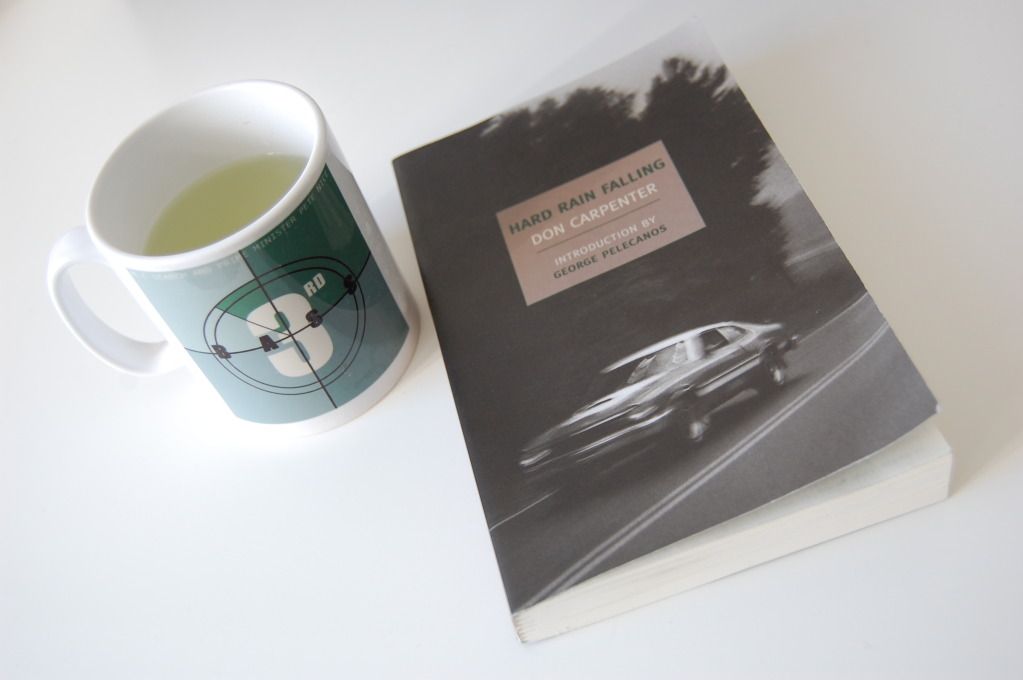
It struck him with a horrible force. His parents, whoever they were, had probably made love out of just such an itch. For fun, for this momentary satisfaction, they had conceived him, and because he was obviously inconvenient, dumped him in the orphanage; because he, the life they had created while they were being careless and thoughtless, was not part of the fun of it all; he was just a harmful side effect of the scratching of the itch; he was the snot in the handkerchief after the nose had been blown, just something disgusting to be gotten rid of in secret and forgotten. Cold rage filled him, rage at his unknown parents, rage at the life he had been given, and for such trivial, stupid reasons! For one wild second of ejaculation! For that, he had been born. This same thing that was keeping him awake nights, and inexorably turning him into a prancing faggot, was the cause of his existence. Fifteen or twenty minutes on a forgotten bed between two probable strangers had given him twenty-four years of misery, pain, and suffering and promised, unless he were to die soon, to go on giving him misery for another forty or fifty years, locked up in one small room or another without hope of freedom, love, life, truth or understanding. A penis squirts, and I am doomed to a life of death. It has got to be insanity; there has got to be a God, because only an insane God could have created such a universe.
Don Carpenter, Hard Rain Falling (1966)
Friday, 9 March 2012
crouching monster
Reading the excellent Patrick Hamilton's The Slaves of Solitude - published in 1947 and set during WWII. A long lifetime away, but anyone who commutes into our capital today will surely think that the opening two paragraphs could have been written about yesterday or tomorrow:
London, the crouching monster, like every other monster has to breathe, and breathe it does in its own obscure, malignant way. Its vital oxygen is composed of suburban working men and women of all kinds, who every morning are sucked up through an infinitely complicated respiratory apparatus of trains and termini into the mighty congested lungs, held there for a number of hours, and then, in the evening, exhaled violently through the same channels.
The men and women imagine they are going into London and coming out again more or less of their own free will, but the crouching monster sees all and knows better.
Saturday, 3 March 2012
tatty
let's play the word association game.
coffee table book. Seinfeld.
no, no... start again...
coffee table book. Habitat catalogue. Coldplay. beige. polenta. drizzle. Snow Patrol. talk of house prices. Florence & the Machine. carefully restored floorboards. moving house to get Josh into a school with no pramface mums or foreigners. Damien Rice. balsamic vinegar...
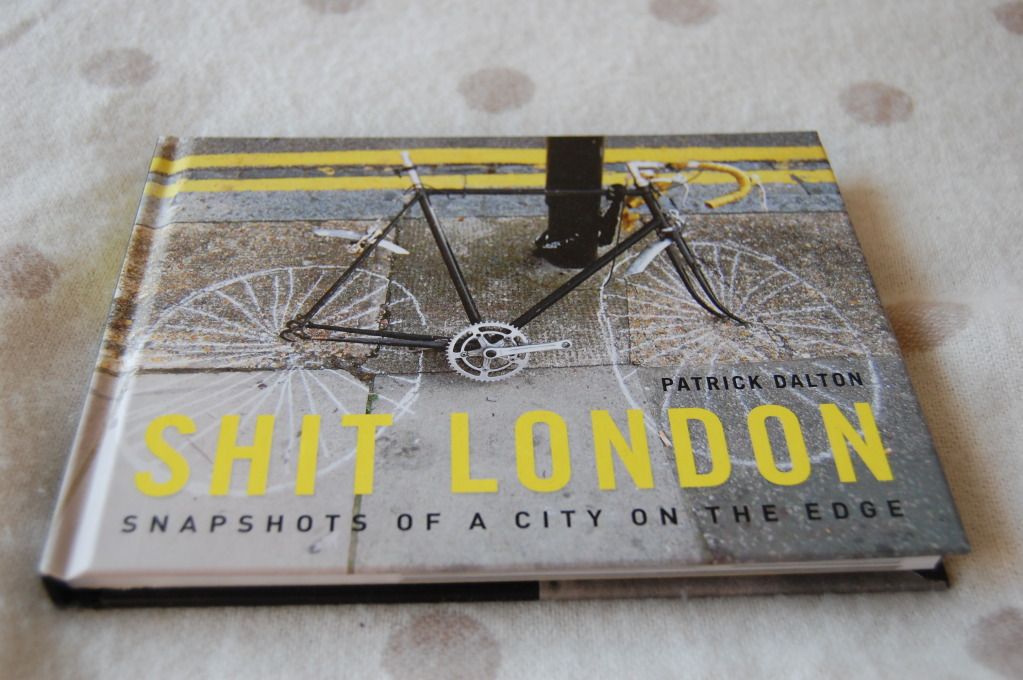
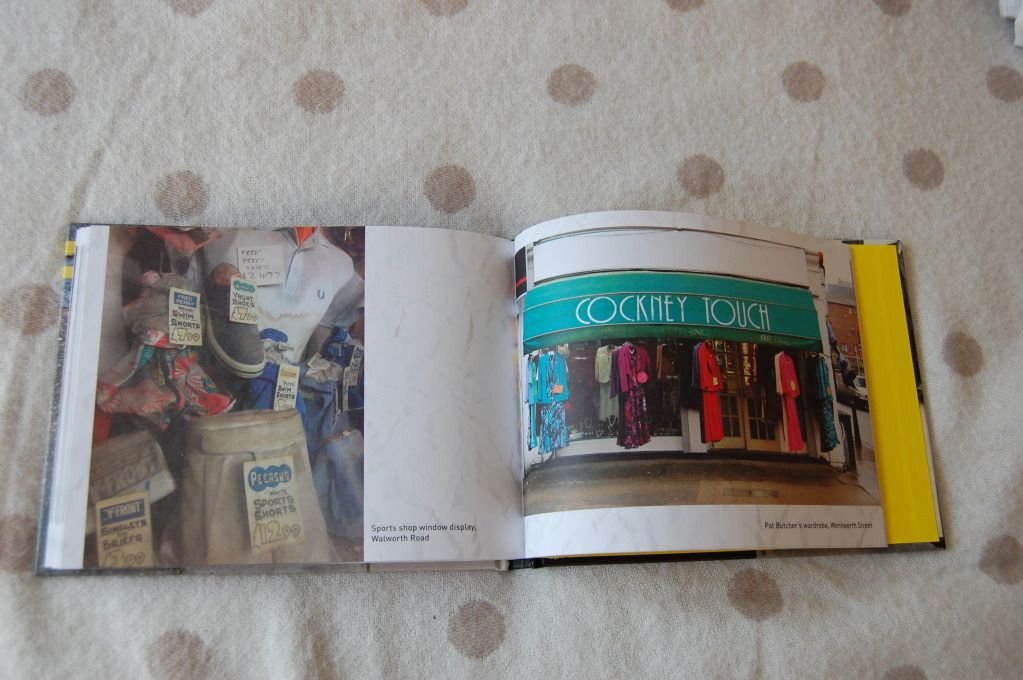
but maybe some coffee table books are alright. maybe SHIT LONDON is alright. maybe it isn't even big enough for the coffee table. maybe it's a bog read instead. either way, Patrick Dalton's round up of aggressive hand-written notices, vandalised signs, horrible shop names, flagrant flytipping etc. is about the non-gloss London lauded only this week here at this is my england. Dalton rightly describes all this quotidian "folk art" as "transient". it's safe to say you'd fail were you to try to find everything he's snapped here. much of it will have been painted over, demolished or shifted in the short time since this little book was printed. get yer camera out. your own SHIT LONDON (or shit wherever-you-live) is all around you. the collection collated by Dalton, meanwhile, is not static. the book is a frozen snapshot. but the pile of glorious wank keeps growing at the website of the same name.
Subscribe to:
Posts (Atom)